
It’s tough to know where to begin, recapping a race that had so many logistical challenges and stress for me at the lead up. I suppose traveling with a bike is second nature to some, but for me, it was one of the biggest stresses of my first half Ironman. I am a novice at best when it comes to bike maintenance and componentry, so putting my bike together from a box was intimidating. All that to say, it helped me understand a key weakness I need to work on for 2020.
In addition to the logistical challenges, I was capped at a personal level. We had completely gutted our house to the studs one month prior to the race, moved from temporary apartment to temporary apartment, started a new job, and was involved with endless new business pitches before I started my new job (read: lots of late nights when you work in advertising). While I was on track to a good training plan in April and May, in June and July (the more crucial months for building speed and strength), I fell short.
There are plenty of triathletes that still manage to stick to a training schedule amidst personal chaos, but for me, it simply wasn’t possible. I know my body, and I can’t survive (or perform well in any capacity — work, home, training) with less than 6 hours of sleep.
Despite trying to drop out of the race, the combination of a non-refundable race entry + non-refundable flight + it being the last year for Ironman in Whistler, inspired (and forced) me to stick to it. While I didn’t get anywhere close to the time I wanted, I’m stoked I stuck with it and can now say my very first Ironman 70.3 was in Whistler, in its (hopefully not final, please come back) year.
See below for my first race recap, which was a lot of fun to write. I hope you find it useful!
Transitions:
It’s important to talk about transitions for a second. This was definitely the most unique differentiator from an Olympic distance, with T1 and T2 in two different locations (and quite far from one another). As a result, the entire day before the race was organizing my things for transitions. I think the most challenging part was that T2 closed at 5pm the day before the race, so I didn’t have time on Saturday to get a bike tune-up. When I woke up on race day, it was the most bizarre feeling to not double check what was at transition, and ensure I had everything I needed.
Swim:
The swim is self-seeding, meaning you predict your finish time and stagger yourself accordingly. I was nervous about this approach, as I’d always started with my age group (much smaller groups). It also meant we’d be waiting around a lot longer — everyone has to line up at the same time, around 6:50 am. It was a long wait until 7:35 when I first hit the water.
My swim started… interestingly. I panicked in my wetsuit (which isn’t entirely new, I really need to get one that fits better), and swallowed a ton of water as it was pretty choppy from all the swimmers. I did breast stroke for probably 600m, which definitely slowed me down but calmed down my breathing. Once I made it to the first turn marker, I had calmed down and got into a good rhythm. I got out of the swim strong and was incredibly pleased with the self-seeding start. Read: no one kicked me, grabbed me, trampled me as per common courtesy in age group starts.
T1:
Given this was my first 70.3, I wasn’t sure what to expect. Volunteers helped me out of my wetsuit, find my transition bag, and when I arrived in the changing tent, I didn’t even really know what I’d need help with. A volunteer came and asked what she could do. I simply asked, “Can you take my sunglasses out of their case?” It’s a small thing, but it really helped and I was grateful for it.
Ride:
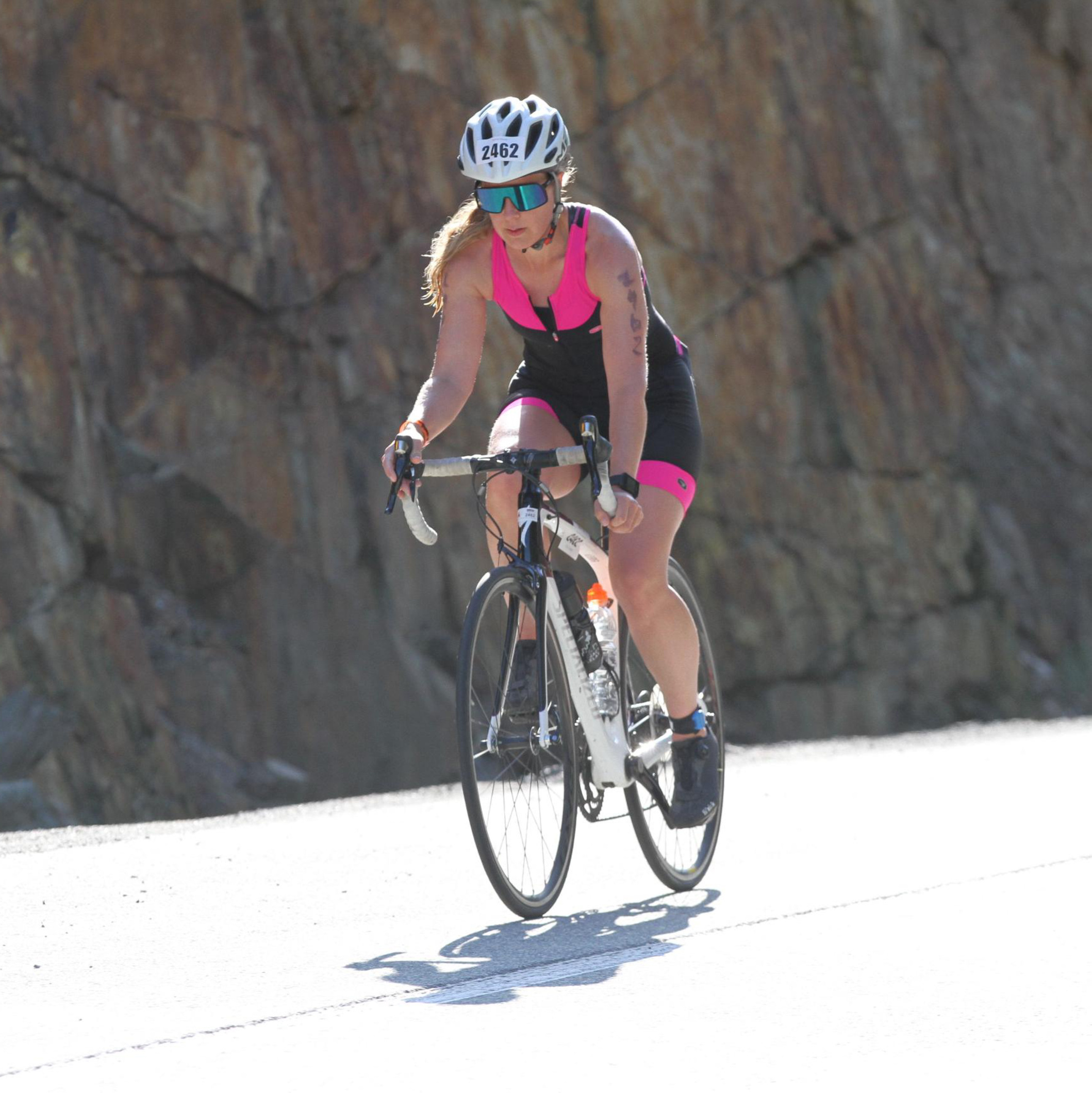
The run to get on the bike felt like it took forever — probably 200m running through cheering crowds (which was awesome, but I wanted to be on my bike ;)). The minute I got on my bike I realized my seat was too low. I had set it at my regular height and ensured during my pre-race ride it was at the right height. I’m not sure if I didn’t tighten it properly or what — but I wasn’t excited about a 90km ride with my knees not at a 90 degree angle. Rookie mistake: I didn’t have an Allen key in my bike kit — only tools to fix my tire.
Luckily I was able to make do, but I know I lost a lot of power, and was using different muscles than I did while training.
My gears also weren’t shifting correctly, and around 25km (during the climb up the Callaghan, switching to first), my chain fell off. The chain inevitably got stuck and it took me a few minutes to yank it out. Covered in bike grease, but stoked I got it free, I hopped back on my bike. There were cyclists absolutely flying down the course while we were climbing up — and truthfully this kept me motivated during the entire climb. I freaking love fast and gnarly descents.
As frustrated as I was with my bike seat and sketchy chain, I focused on the positives. The scenery and the energy was next level, and I caught myself grinning ear to ear for the majority of the first 40km.
Then the turn onto Sea-to-Sky highway. Everyone had always talked about the Callaghan climb being the brutal part of the bike (roughly km 18 to km 30), yet when I turned onto the highway and noticed us going ever so slightly downhill for 20+ km’s, I got nervous. And rightly so. The ride back to Whistler was into a headwind and net uphill. Not steep like Callaghan, but a consistent incline. Not my forte, especially with a bike that just didn’t feel right.
The course in town was confusing… luckily I didn’t get lost, but I was uncertain where the 70.3 turn off was (the full was on the same day). Needless to say, I finished my 90km ride with a bike that wasn’t fit or tuned properly, and was pleased with a 3:20 finish tackling 1200m of elevation.
T2:
The scariest part of this race mentally was my jog off the bike and into the run transition. My legs felt useless. Between the odd bike position and endless climbing, I honestly didn’t know how I’d be able to run a half marathon. The volunteers — again — were amazing, and with some proper refuelling and a bio break, I was ready to test out my legs.
Run:
Oh the run. I told myself over and over again not to go out too strong. As a result, I perhaps didn’t go out strong enough. My legs were feeling good and I was shocked that my knees weren’t bugging me after the ride. The first few km’s were hilly and through a forest on a gravel trail. I was blown away by how beautiful it was. I had lived in Whistler but only for the winter — so the summer was a nice treat to see what was under those frozen trails.
Once we got out of the forest and onto the exposed boardwalks I was in a lot of trouble — I think around 7km. In my head I told myself it was way too early to be feeling rough; I had to pull it together.
Around 12km I hit a wall. Perhaps a mental wall but also a physical wall — I was starting to feel defeated. I stopped at every single aid station. I was salt deprived, and wished I had brought salt pills (which I hadn’t thought of, nor trained with, yet another sign I should have better trained with nutrition). I frantically ate chips at the aid stations, hoping that would increase my salt intake, but unfortunately it wasn’t enough.
I stopped to stretch. I stopped to walk. I truly took my time on the run and looking back I wish I had rallied — but at the moment I was just so grateful for the beautiful scenery and for my body that had allowed me to get that far.
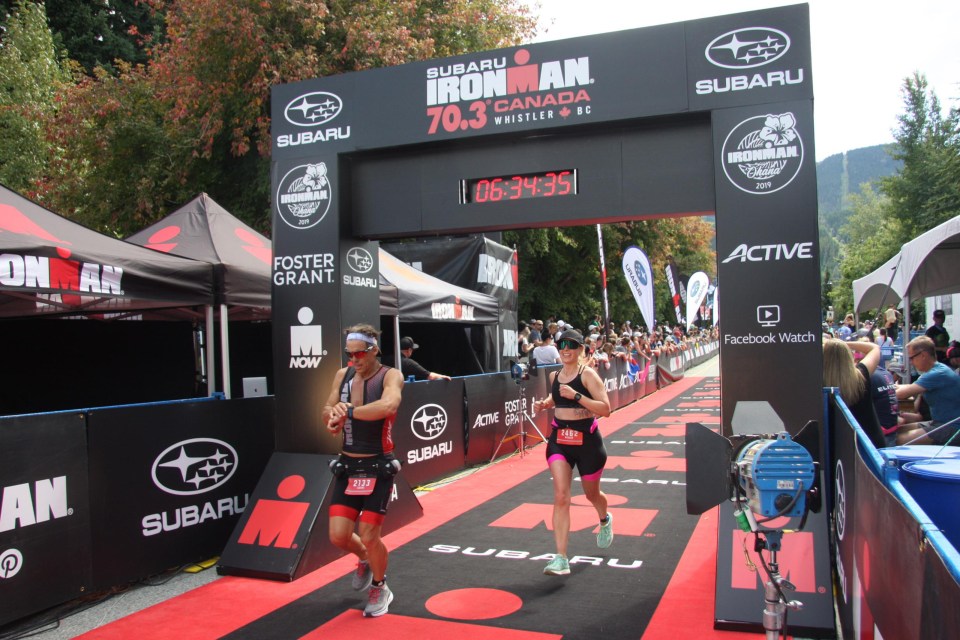
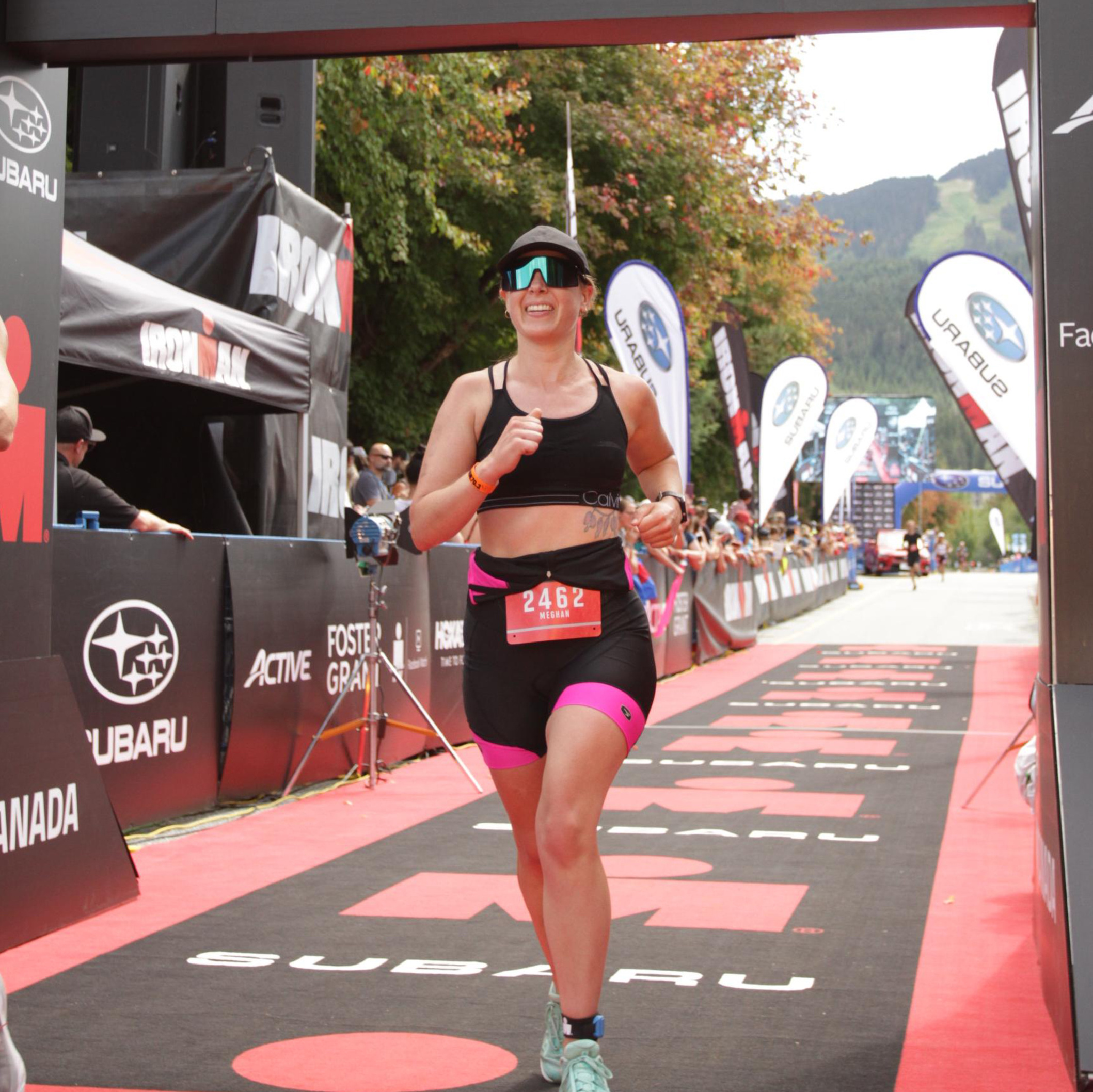
The finish was almost anti-climactic. You come out of the Valley trail and you can see the finish, but you’re directed through the village and around. By that point I had already mentally checked out — so this winding trail was a killer. There were crowds cheering which helped, but I wasn’t feeling that (what felt like) “extra” 800m through the village.
The finish line was emotional. I had a lot of personal things going on in July and I carried that through the finish line. Having my Whistler pals (who I only see about once a year, and are still some of my closest friends), at the finish line pushed me over the edge. I was proud and thankful my body was able to do that type of race, and reflected on all of the people I know who would love to test their body like that but can’t.
I am beyond grateful to have so many people in my life that support my craziness, with a solid community of support in BC. And while the above probably sounds like I’m whining about the struggles, it was all incentive for me to try my hand at another 70.3 and achieve my sub-6 hour goal I had initially set out for in Whistler. And you wonder why they say triathlons are addictive.
 meghan jeffery