

Why is it that bad habits are so easy to start? Yet when we attempt to develop a good habit, we’re faced with roadblocks and sneaky bad habits trying to worm their way into our personal achievements.
In 2016, at the ripe age of 29, I developed a really healthy habit. I started running. I also started reading before bed (so long Netflix), and as a result of that new habit, stumbled across Charles Duhigg’s New York Times Best Seller The Power of Habit. Prior to reading the book, I had heard the usual myth that habits take 21 days to develop, but I’d never stopped to consider just how much psychology goes into changing one particular aspect of your life. I’d started running, finally, after years of failed attempts, so what had suddenly changed?
According to Duhigg, it’s all about the habit loop and our understanding of it. The habit loop begins with a cue, is followed with a routine, and at the end, there’s a reward. It can take a little while to recognize the reward, but after many repeated routines, you’ll learn to anticipate the reward before the cue even presents itself, and voila: a habit is formed.
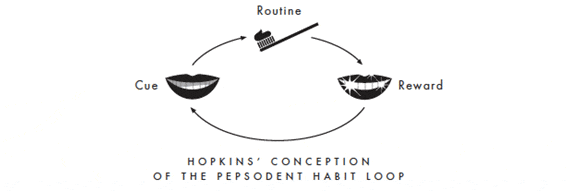
What’s important to understand is the reward. There are the obvious benefits (or rewards) to running, which to most (including myself) is losing weight. Yet while I’d seen the benefits of losing weight in the past, I’d never been able to make it a habit.
What changed this time? Only 2 chapters deep in Duhigg’s book, I realized my reward was much different this time around, and that is thanks to a handy little app called Strava. (Strava is a GPS tracker, typically used for cyclists and runners).
I started tracking the analytics from my runs. I noticed trends and was able to pinpoint what time of day I was faster, what temperature I ran best in, and where I could improve hill times or sprints. I loved competing with myself. I loved watching my improvements, becoming nearly addicted. If I could shave off 30 seconds of my time, I was ecstatic. Sure, I had a few followers, but I wasn’t doing it for them — this was pure competition with my old self thinking I couldn’t become a runner.
So how does this tie back to my career in social? I’ll let you in on a secret. Digital marketers are driven by analytics. In fact, we’re obsessed. Every Facebook post we upload and every Instagram Boomerang we post — we’re watching the back end to ensure it’s performing as intended (and no, not just likes and comments, also reach and impressions). If it doesn’t perform well, we shift strategy to ensure we’re continually moving forwards — not backwards.
My reward this time around looked a lot different than the typical losing weight reward. Data was instant, and was paramount in my decision to lace up my shoes each morning. These were tangible results that I could look at and read and share with my running friends (or non running friends, to their boredom). It was brilliant. When I woke up in the morning, I automatically began envisioning the reward (maybe I’ll be faster today, I feel lighter) which made the cue (lacing up my running shoes) a habit rather than a struggle. Then the reward? Data to analyze, track, and become a better runner.
Call it a long shot but it’s true. I credit my running habit (which is now a full blown habit, that I don’t ever see going away unless I become injured) from my love of data and results, which I’ve inherited from my career in digital media.
What habits are you trying to change? Consider the habit model: cue, routine, and reward, and really think about what your reward is. It may not be as obvious as you think.
Watch Duhigg’s 15-minute TedX talk below, though I strongly suggest picking up a copy of the book, too.
Photography by Lululemon Toronto.
 meghan jeffery